In this article, we will continue our description of different optical instruments used by optometrists. Last time we talked about Ophthalmoscopes, today we will talk about another very common optical instrument called the Keratometer.
The keratometer was developed in 1851, it is used to measure the curvature of the anterior cornea. That is the outer layer of the cornea. Keratometers use an object of known size and by modifying the distance to the cornea they create an image of specific size.
The anterior corneal curvature is then obtained from the convex mirror formula and corneal power is calculated using Snell’s law of refraction with simplified optics. To account for errors caused by the cornea thickness and the curvature of the posterior surface keratometers use a refractive index of 1.3375, instead of the more accurate value of 1.376.
When utilizing a keratometer, two images of a target mire are created. Crosses or circles with marks along the outside might be used as the mire. These photos may be out-of-focus, in which case an optical professional will adjust the object’s distance until the image is sharp. The target is denoted by a circle with a cross symbol in the center.
The cross should be in the center of the circle. The curvature is measured using the upper and left markings. We can quantify that curvature by changing those photos until the lateral markers are superimposed. We can observe the three different markings before and after alignment in Figure 1.
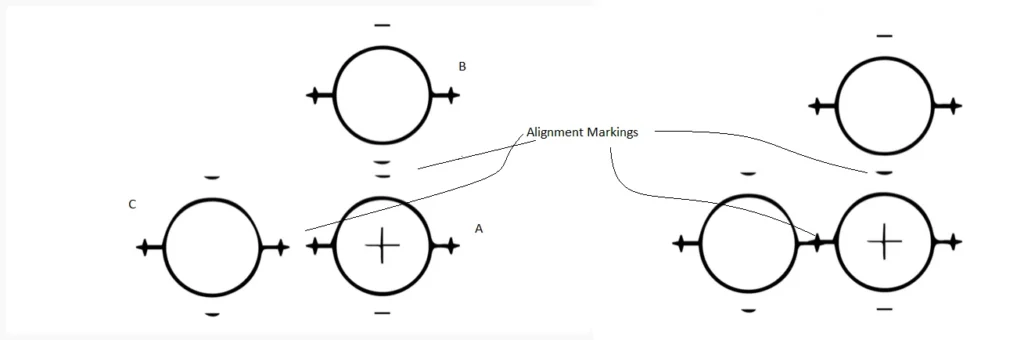
It is important to mention that in the case of an astigmatic eye, both marks wont be able to be superimposed simultaneously.
In figure 2 we show a basic layout of a keratometer. We will describe the basic elements, although we won’t be able to mention any of the specific details about the optical components, we will be able to describe their basic functions.
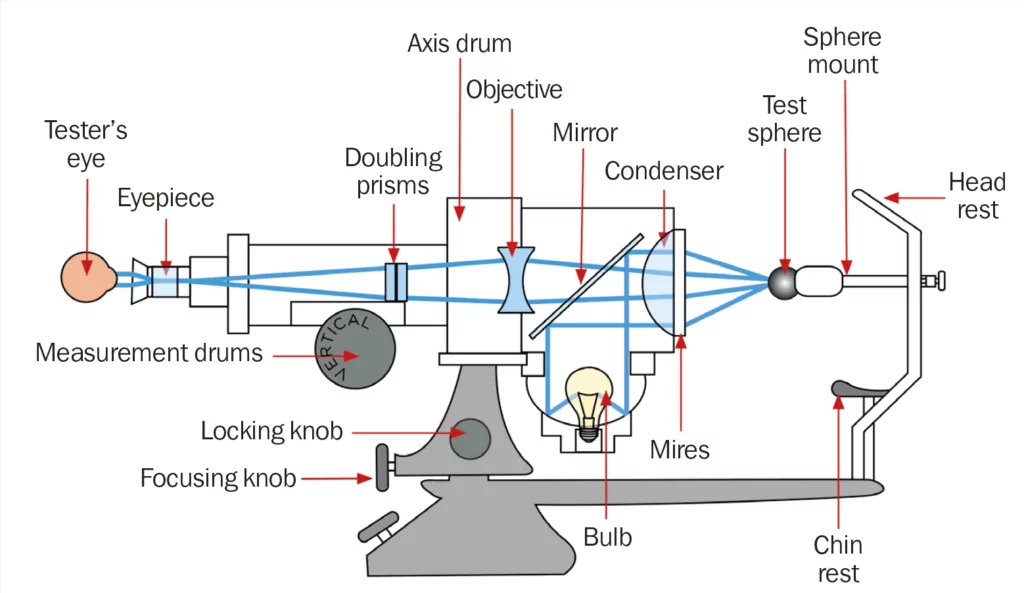
In the figure we are showing a test sphere instead of a patient’s eyes. Several of the components shown are used to control the illumination. The mires are placed on its own mechanical fixture that allows for the control of their position as explained before.
One problems when measuring the cornea curvature, is that the eyes are in constant movement. In order to help stabilize the image long enough to perform the required measurements it is common to use a double prism. Finally we have optical elements that are used to create an image that can be captured by an eyepiece and the operator.
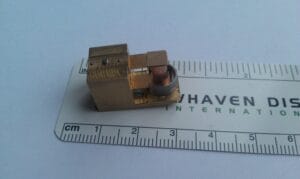
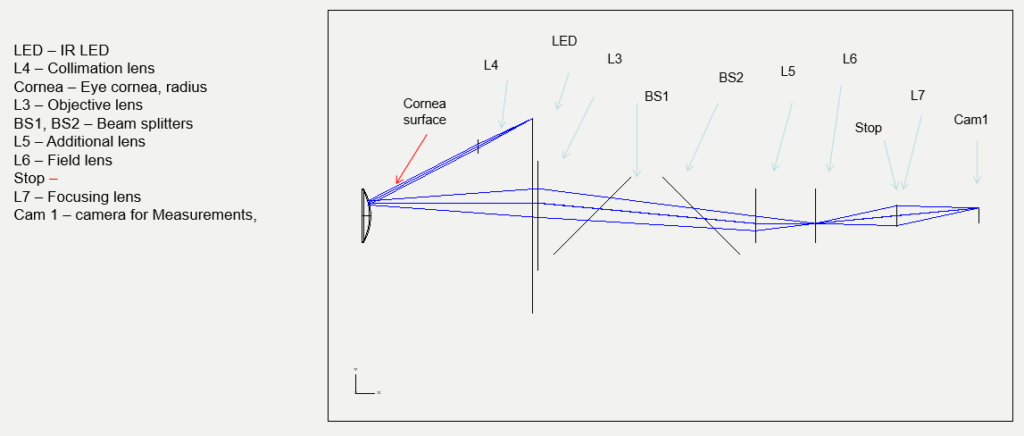
In modern systems it is possible to replace the eye of the operator by a camera. One of such devices is shown in Figure 3. Figure 3 was developed by OpticsForHire, although we can go into details of the system, the basic operation is pretty similar to the one that we just described. Notice that the mires and mechanical positional components are not shown.
FAQs: Keratometers
What is a keratometer and what does it measure?
A keratometer is an ophthalmic instrument used to measure the curvature of the anterior surface of the cornea. By analyzing reflected images of a known target, the device estimates corneal radius and calculates corneal power, which is critical for vision assessment and lens fitting.
Why does a keratometer treat the cornea as a convex mirror?
The anterior cornea reflects light similarly to a convex mirror. By observing how a target of known size is reflected and magnified, the keratometer can infer corneal curvature using mirror equations. This simplified model enables repeatable measurements without imaging deeper ocular structures.
How does a keratometer determine corneal power?
Corneal power is calculated from the measured radius of curvature using Snell’s law of refraction. Keratometers apply a standardized refractive index to account for corneal thickness and posterior surface effects, allowing curvature measurements to be converted into diopters.
Why is a refractive index of 1.3375 used instead of the true corneal index?
The value 1.3375 compensates for simplifications in the optical model by approximating the combined effect of the anterior and posterior corneal surfaces. Using this adjusted index reduces systematic errors when estimating corneal power from anterior surface curvature alone.
What are mires and why are they used in keratometers?
Mires are illuminated targets of known geometry used to probe corneal curvature. Their reflected images change size based on curvature, allowing the operator to adjust alignment until reference marks coincide. This process enables accurate determination of corneal radius.
Why do keratometers produce two images of the mire?
Two images are generated to enable differential measurement of curvature. By adjusting the optical system until specific markings overlap, the instrument quantifies corneal curvature along principal meridians, improving measurement precision and repeatability.
How does astigmatism affect keratometer measurements?
In astigmatic eyes, the cornea has different curvatures along orthogonal meridians. As a result, mire markings cannot be aligned simultaneously. Keratometers measure each meridian separately to determine the magnitude and orientation of corneal astigmatism.
Why is eye motion a challenge in keratometer design?
The eye is rarely stationary, which can blur reflected images during measurement. Optical elements such as double prisms help stabilize the image long enough for alignment, reducing motion-induced errors and improving measurement reliability.
What role do prisms play in keratometer optics?
Prisms are used to split and laterally shift reflected images of the mire. By controlling image separation and overlap, prisms allow fine adjustment of the measurement scale and enable precise determination of corneal curvature.
How do modern keratometers differ from traditional designs?
Modern keratometers often replace the operator’s eye with a digital camera and image processing system. While the optical principles remain similar, automated alignment and analysis improve measurement speed, repeatability, and integration with other diagnostic systems.