Introduction
When working with lasers it is important to understand the physical parameters that define system performance. While some of these specifications may be readily recognizable, such as wavelength and divergence, others may be lesser-known, yet equally critical metrics. For instance, concepts like the M-factor, beam caustic, and Rayleigh Range often have immense significance in shaping the behavior and efficacy of laser systems. Working with these parameters requires a deeper understanding of the interplay between light, optics, and the underlying physics governing laser technology.
Basic Principles of Rayleigh Range
Named after the eminent British physicist Lord Rayleigh, the Rayleigh Range delineates the distance over which a laser beam’s intensity remains relatively stable before significant divergence takes place. At its core, the Rayleigh Range is a manifestation of diffraction, the phenomenon whereby light waves bend around obstacles or edges. As a laser beam traverses through space, diffraction gradually causes it to spread out, ultimately leading to divergence. The Rayleigh Range signifies the domain within which the beam’s width approximately doubles from its initial dimensions, while its intensity distribution conforms to a Gaussian curve.
In this article I would like to talk a little bit more about the concept of laser Rayleigh Range. In order to start the explanation, please see, in figure 1, an hypothetical Gaussian Beam after being focused by a lens.
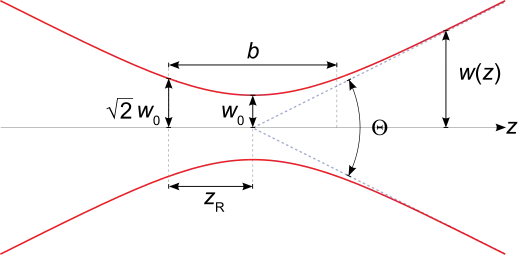
In order to explain the laser Rayleigh range we need to understand the concept of beam waist. Even though we may imagine that light from a laser is perfectly collimated and doesn’t change dimensions, the truth is that it will have some divergence, meaning that the diameter of the beam will increase as it propagates in space. There will be one point in which the beam diameter will be the smallest, that’s what we called the beam waist (w0) and we usually use it as an origin to start measuring the z-direction. So by definition, the origin (z=0) is located at the beam waist.
From there we can define the Rayleigh Range as the distance from the beam waist where the area of the Gaussian beam doubles, or in other words, where the diameter of the beam increases by sqrt(2) times the beam waist. This can be expressed in a formula as:
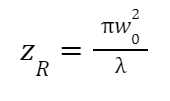
Where λ is the wavelength.
Twice the Rayleigh Range is called the confocal distance or more commonly known as the depth-of-focus. Which can be understood as a tolerance of where the image plane can be placed without a lot of image degradation. If any of you is familiar with photography, the depth-of-focus is where the image will appear to be in focus on the camera sensor.
Another reason why the Rayleigh range is important is that within this range the divergence of the beam is very small. So if you are in need to work with a highly collimated beam, your best chance is to work with a beam with a large Rayleigh Range.
In terms of field of curvature, within the Rayleigh range we can consider that the Gaussian Beam has a plane wavefront (with a Gaussian Intensity distribution), while beyond the Rayleigh range the wavefront can be considered spherical. That change in wavefront can help us to simplify or to better model our optical system, specially if needing to work with diffractive elements or near the diffraction limits.
Understanding the Significance of Rayleigh Range in Laser Applications
By understanding the Rayleigh Range, engineers can meticulously tailor the focusing conditions of the laser beam, ensuring optimal intensity and minimal divergence throughout the machining process. Similarly, in medical fields such as laser eye surgery, precise control over the Rayleigh Range enables surgeons to deliver focused laser beams with great accuracy, facilitating delicate procedures with enhanced efficacy and safety.
Furthermore, in the areas of telecommunications, where laser beams serve as carriers of information over extensive distances in free-space, the Rayleigh Range assumes a pivotal role. It aids in predicting signal degradation, optimizing transmission efficiency, and ultimately, ensuring seamless communication networks.
Exploring Practical Examples
To fully appreciate the impact of Rayleigh Range, let us deal into practical examples that underscore its significance in real-world scenarios. Consider the domain of laser cutting, where high-powered laser beams are employed to slice through materials with surgical precision. By strategically manipulating the Rayleigh Range, operators can ensure that the laser beam maintains optimal intensity and focus, thereby facilitating immaculate cuts across a diverse array of materials, ranging from metals to acrylics.
Furthermore, in the realm of biomedical research, laser scanning microscopy stands as a testament to the indispensable role of Rayleigh Range. By harnessing precise control over the Rayleigh Range, researchers can capture high-resolution images of biological specimens with unparalleled clarity, enabling detailed analysis and elucidation of intricate cellular structures.
Recent Advances and Future Outlook
Adaptive optics techniques are methods that dynamically adjust optical elements in real-time. This approach enhances our capability to finely tune and optimize the Rayleigh Range with great precision. By adapting the optical components to changing environmental conditions and inherent system fluctuations, adaptive optics allow laser systems to maintain optimal performance across a wide range of applications. This dynamic optimization not only ensures maximum efficiency but also opens doors to new areas of precision engineering and scientific exploration.
Conclusion
In conclusion, this article has explain some of the fundamental concepts of Rayleigh Range in laser technology, emphasizing its role in various applications. Practical examples have illustrated how precise control over the Rayleigh Range can lead to improved outcomes in fields ranging from laser cutting to biomedical research. Furthermore, discussions on recent advances such as adaptive optics have highlighted the continuous evolution of laser technology and its potential for future innovations. Overall, the article underscores the importance of understanding the Rayleigh Range in harnessing the full potential of lasers for diverse applications.
FAQs: Rayleigh Range
What is the Rayleigh Range in laser technology?
Rayleigh range is the distance from the beam waist over which a Gaussian laser beam remains relatively well focused. At one Rayleigh range from the waist, the beam radius increases by a factor of √2, meaning the beam area doubles compared to the waist location.
How does Rayleigh Range affect laser beam quality?
Rayleigh range determines how long a beam stays tightly focused before diverging significantly. A longer Rayleigh range generally supports a more collimated region and a larger depth-of-focus, which can improve process stability in applications like cutting, scanning, and precision illumination.
Can Rayleigh Range be adjusted in laser systems?
Yes. Rayleigh range can be adjusted by changing the beam waist size or the focusing conditions of the beam. In practice, this is done by selecting different lenses, beam expanders, input beam diameters, or optical configurations that alter the focused waist and divergence.
What is the relationship between Rayleigh range, beam waist, and wavelength?
For an ideal Gaussian beam, Rayleigh range increases with the square of the waist size and decreases with increasing wavelength. This is why tightly focused small waists have short Rayleigh ranges, while larger waists produce longer propagation distances with lower divergence.
What is the confocal parameter and how is it related to Rayleigh range?
The confocal parameter is twice the Rayleigh range. It describes the full length of the region around the waist where the beam remains relatively narrow. In many contexts it is treated as a laser “depth-of-focus” or tolerance region for maintaining near-constant spot size.
Why is Rayleigh range often described as a “depth-of-focus” for lasers?
Within ±Zr of the waist, spot size and intensity vary less dramatically than farther away. This makes it a practical region where positioning errors, focus drift, or target height variation have reduced impact on delivered intensity and feature size, especially in machining or scanning systems.
What happens to the wavefront curvature near and beyond the Rayleigh range?
Near the waist, the wavefront curvature is relatively small and can be approximated as nearly planar over short distances. Beyond the Rayleigh range, the wavefront curvature becomes more pronounced and is often treated as spherical, which matters for modeling diffraction-limited propagation and phase-sensitive optics.
When does Rayleigh range matter most in real laser applications?
It matters when intensity at the target must be stable over distance, such as laser cutting, engraving, microscopy, free-space optical links, and medical procedures. In these cases, Rayleigh range informs spot size stability, tolerance to defocus, and achievable energy density at the work plane.
How does Rayleigh range relate to beam divergence?
Rayleigh range and divergence are linked through the same Gaussian beam parameters. A short Rayleigh range implies rapid divergence after the waist, while a long Rayleigh range implies slower spreading. Designers often balance waist size and divergence to meet working-distance and spot-size requirements.
How do real (non-ideal) laser beams affect Rayleigh range calculations?
Real beams often deviate from a perfect Gaussian, which is captured by the M² factor. When M² is greater than 1, the beam diverges faster and behaves as if it has a shorter effective Rayleigh range for a given waist and wavelength. Using M² helps set realistic expectations for propagation.
How can you increase Rayleigh range without reducing intensity too much?
Increasing Rayleigh range typically requires increasing waist size, which reduces peak intensity at focus. One approach is to optimize the tradeoff by choosing a waist that meets minimum intensity requirements while expanding the depth-of-focus. Beam shaping, higher power, or different focusing optics may also be used to preserve usable intensity.
What is a common mistake when specifying Rayleigh range for a laser system?
A common mistake is assuming the beam is perfectly Gaussian and ignoring M², alignment errors, and lens aberrations. Another is specifying a long Rayleigh range while also demanding an extremely small spot size, since those requirements directly compete in diffraction-limited systems.
How should Rayleigh range be reported in documentation or test results?
Report Rayleigh range together with wavelength, measured or assumed beam waist, M² (if available), and the measurement method. Without those details, Rayleigh range values can be misleading or not comparable across systems and vendors.