Projection systems are one of the most common consumer optical devices (probably second to photographic systems). They allow us to view images on a screen (usually) by magnifying and projecting them at distances from a few centimeters to several meters away (like in a movie theater), while maintaining a high quality image. Projection systems are also used in industrial and scientific applications.
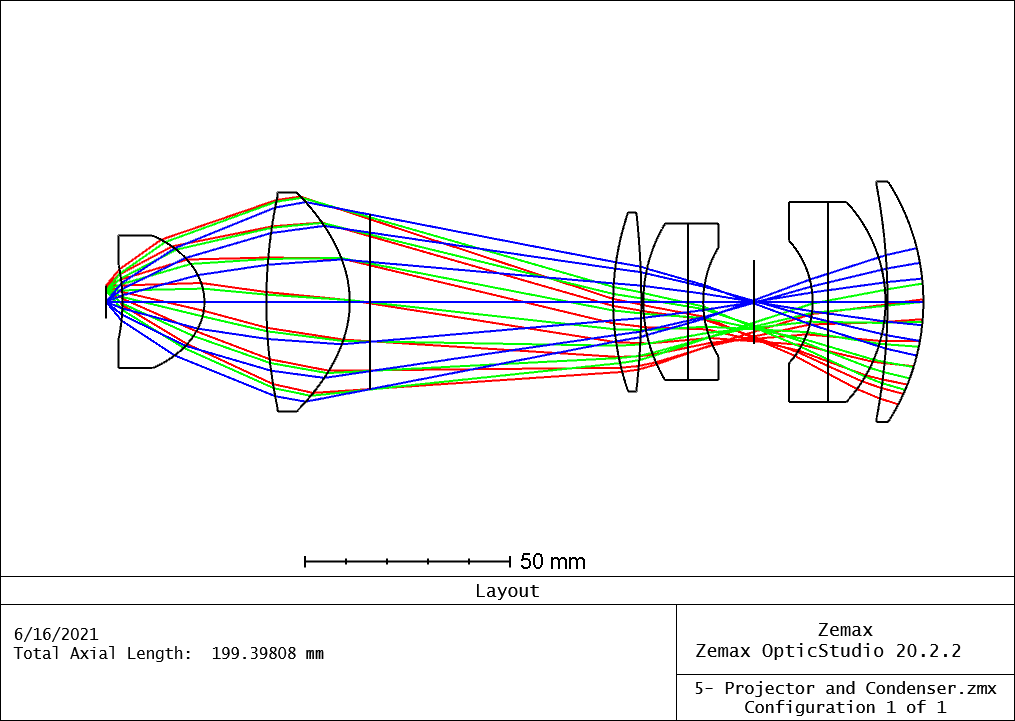
Typical designs allow for the image to be focused at different distances (zoom projector lenses); this requires multiple optical elements to work together and depending on the use, may need to provide continuous zoom or have discrete fixed zoom locations. Since the main purpose of a projection system is to create a high quality image, it is important to reduce all possible aberrations. In Figure 1, for example, we can see the combination of several double achromats used to reduce spherical and chromatic aberrations, as well as the use of negative and positive elements to correct for distortion and coma.
In addition to reducing aberration, there are different parameters to take into account when designing a projection lens. These parameters define the kind of illumination to be used, the working distance, and the location of the object and image with respect to the optical axis.
You can read more about the optomechanical methods to move lens groups for a zoom lens in this link.
Throw Ratio
Throw ratio is the relationship between the size of the image created on the screen and the distance at which the projector is placed. If a projector lens has a “small throw”, it means that it can be placed close to the screen and still produce a large image.
A small throw projector can be desirable because it can be placed in smaller rooms but it requires a more complex optical system design to reduce aberrations like distortion and chromatic aberration and this can lead to higher prevision element which means higher costs systems.
Offset
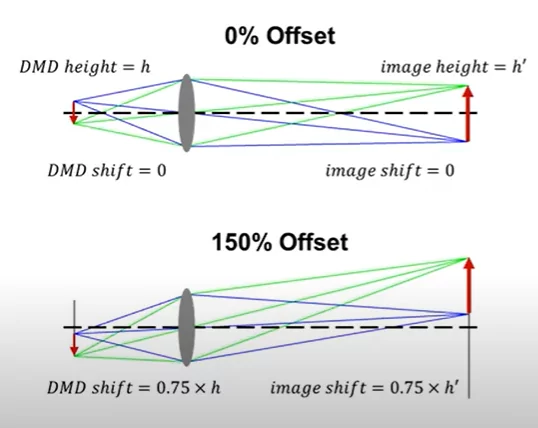
Offset refers to a shift of the object from the center of the optical axis. This creates an image that will also be displaced from the optical axis. Offset is sometimes required to avoid obstruction of the image by objects along the optical axis; for example, if the projector is sitting on a table, the table may block part of the image, or if the projector is close to the ceiling, we want to avoid blocking the image by it. It is possible to design systems with variable offsets but that requires a more complex optical design. It is more common, and cost effective, to design systems with a fixed offset (usually between 100% – 130%).
Illumination: Telecentric vs. Non-Telecentric
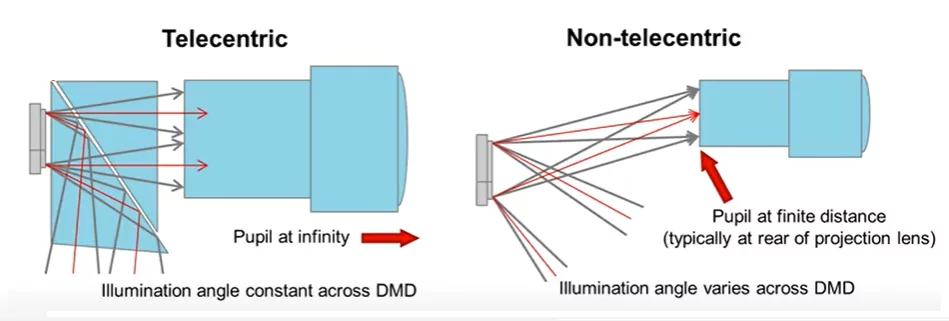
The illumination configuration can be telecentric or non-telecentric. In a telecentric system, the angle of incidence of light illuminating the object is constant which in return creates a more uniform brightness on the image. They can be designed with a variable offset (from 0% – 130%). The illumination system can be independent from the projection lens, so it’s possible to exchange one without modifying the other. As a drawback, they tend to be more expensive and include more elements than a non-telecentric system.
In a non-telecentric system, the illumination is not constant and it’s usually at an offset angle, so the image brightness is also affected by this. They tend to have a lower cost than a telecentric system, but they have more design limitations. As an example, all non-telecentric systems have to have a fixed offset.
FAQs: Projection Lens Design
What is a projection lens?
A projection lens is an optical system designed to form an enlarged image of a source object, such as a microdisplay, mask, or slide, onto a distant screen or surface. Unlike imaging lenses used for sensors, projection lenses are optimized to deliver uniform illumination, controlled distortion, and high image quality over a large projected field.
How is projection lens design different from camera lens design?
Projection lenses work in reverse compared to camera lenses. Instead of capturing light from a scene and forming a small image on a sensor, projection lenses expand a small source into a large image. This reverses many design priorities, such as chief ray angles, telecentricity requirements, and illumination uniformity across the image plane.
Why is telecentricity important in projection systems?
Telecentricity helps maintain constant magnification across the projected field and minimizes keystone distortion. In many projection applications, especially those involving structured light, lithography, or precision displays, maintaining near-telecentric rays ensures consistent image scaling and alignment on the projection surface.
What are the main optical challenges in projection lens design?
Key challenges include managing distortion over large fields, maintaining high MTF across the image, controlling chromatic aberration across the operating wavelength range, achieving sufficient brightness, and ensuring uniform illumination. Thermal effects and packaging constraints can also strongly influence the final design.
How does distortion affect projected images?
Distortion causes geometric deformation of the projected image, such as barrel or pincushion effects. In projection systems, distortion is often more noticeable because the image is enlarged. Some applications allow digital correction, while others require the optical design itself to minimize distortion to very tight tolerances.
Why is illumination uniformity critical in projection lenses?
Non-uniform illumination leads to brightness variations across the projected image, which can degrade perceived image quality or measurement accuracy. Projection lenses are often designed alongside illumination optics to ensure even light distribution across the entire field.
What role does numerical aperture play in projection lens performance?
The numerical aperture determines how much light the lens can collect and project, directly influencing brightness and resolution. Higher NA improves light throughput and potential resolution but increases sensitivity to aberrations, alignment errors, and manufacturing tolerances.
How are chromatic aberrations handled in projection lenses?
Chromatic aberrations are controlled through careful glass selection, achromatic or apochromatic group design, and optimized element spacing. Because projection systems often operate over wide spectral ranges, chromatic correction is a major driver of lens complexity.
Can projection lenses be customized for specific display technologies?
Yes. Projection lenses are frequently tailored for specific source types such as DLP, LCD, LCoS, or laser-based systems. Each source has unique angular distributions, polarization characteristics, and spectral behavior that influence the optical design.
When is a custom projection lens required instead of an off-the-shelf solution?
Custom projection lenses are typically required when off-the-shelf optics cannot meet constraints on field size, working distance, distortion, brightness, wavelength range, or mechanical packaging. Specialized industrial, scientific, and medical applications often fall into this category.
How is projection lens performance evaluated?
Performance is evaluated using metrics such as MTF across the field, distortion maps, illumination uniformity, chromatic focus shift, and stray light analysis. In many cases, simulation results are validated with prototype testing to confirm real-world behavior.