Introduction
When thinking of a ‘lens’, most people have the image of a spherical lens in their mind, but there are different geometries for lenses, and one of the most common is the cylindrical lens. What’s the difference between spherical and geometrical lenses? And what applications require cylindrical lenses? In this article we will discuss these questions.
Cylindrical vs Spherical lenses
Imagine a sphere made out of glass and let’s say we cut at any plane completely across the sphere. Our end piece will be a spherical lens, with a flat surface and a curved surface. If we were to illuminate the flat side with a light source, we will see that all of the light is focused to a single point some distance in front of the lens. If we rotate a spherical lens, the position and shape of the focused light wouldn’t change
Now imagine that, instead of cutting a glass sphere, we cut a glass cylinder. We need to cut the cylinder with a plane parallel to its axis of rotation (that would be the longest axis). We end with a lens that is flat on one side and curved on the other. However, the curve of a cylindrical lens only goes in one direction. Why is that important? Well, because when we illuminate a cylindrical lens, instead of the light focusing into a point it will focus into a line. Not only that, if we rotate the cylindrical lens along the optical axis, the focused line will change its orientation.
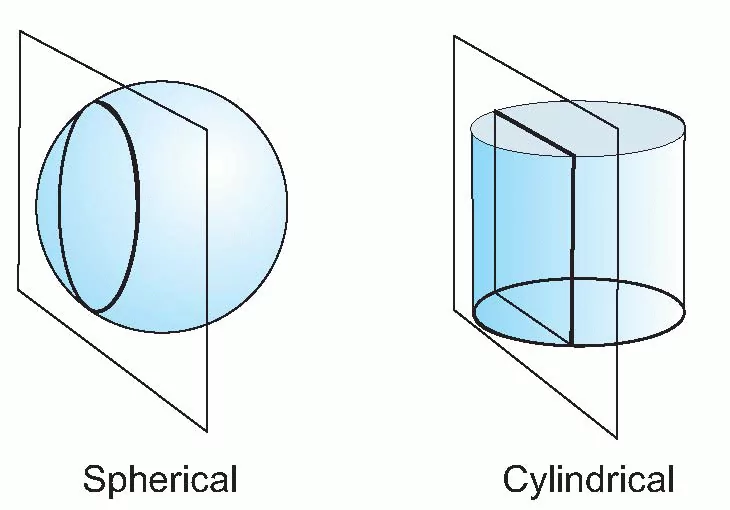
Now, we might ask ourselves why do we ever want to use a lens that is clearly distorting the shape of our light source to a single line. Cylindrical lenses actually have several applications that make them very useful, and sometimes necessary, in optical systems
5 Applications of Cylindrical Lenses
Correcting Astigmatism
Astigmatism is an optical aberration that can cause images to appear distorted or blurred. It occurs when light rays entering the eye or an optical system are not focused equally in all directions, leading to different focal points in different planes.
A cylindrical lens is designed to have a different refractive power in one axis compared to the other, which allows it to focus light in only one plane. This means that when light passes through a cylindrical lens, it is focused differently in the vertical and horizontal planes.
In the case of astigmatism, a cylindrical lens is placed in the optical system to correct for the difference in refractive power in the two planes. By aligning the axis of the cylindrical lens with the direction of the astigmatism, the lens can compensate for the difference in focal points in the two planes and bring them into alignment, resulting in a clearer, sharper image.
In short, a cylindrical lens corrects astigmatism by focusing light in only one plane, compensating for the difference in refractive power in the two planes and bringing them into alignment.
Laser Beam Shape Correction.
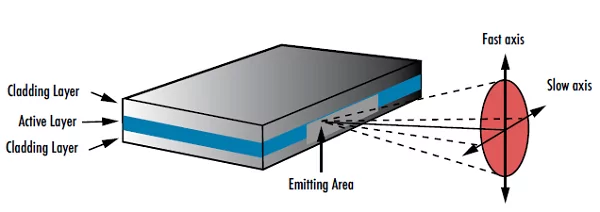
Ideally, light emitting from a laser should be a perfect circle; however, semiconductor laser present an elliptic beam profile. So it is necessary to correct the beam profile so we can collimate the beam and couple it to an optical fiber. We can correct such profile by placing a cylindrical lens with its main axis perpendicular to the fast axis of the laser beam.
Cylindrical lenses are commonly used in laser beam shape correction to reshape the laser beam and improve its quality. Laser beams often have non-uniform intensity profiles or non-circular shapes due to imperfections in the laser cavity or the mode of operation. Cylindrical lenses can be used to correct these distortions and produce a more uniform and circular beam.
When a laser beam is passed through a cylindrical lens oriented at a specific angle, the lens refracts the light in one direction more than the other. This causes the beam to become elliptical in shape, with one axis being more expanded than the other. By carefully selecting the orientation and position of the cylindrical lens relative to the laser beam, it is possible to shape the beam into a more uniform and circular profile.
Optical Spectroscopy
Cylindrical lenses are used in optical spectroscopy to control the spatial and spectral properties of light in the optical path. Spectroscopy is a technique that measures the interaction of light with matter, and it is widely used in fields such as chemistry, physics, and biology to study the composition and properties of materials.
One common application of cylindrical lenses in spectroscopy is in the design of monochromators, which are devices used to separate light into its component wavelengths for analysis. Cylindrical lenses can be used to focus the light onto a diffraction grating or prism, which disperses the light into its constituent wavelengths. By carefully selecting the focal length and orientation of the cylindrical lens, the width and height of the beam can be controlled, ensuring that the entire spectrum of the light is properly dispersed.
Laser Line Scanning
Cylindrical lenses are widely used in laser line scanning to shape the laser beam into a thin, straight line that can be scanned across a surface to generate a high-resolution image or 3D profile. Laser line scanning is used in a variety of applications, such as 3D metrology, quality control, and machine vision.
To create a laser line, a cylindrical lens is placed in the optical path of the laser beam, perpendicular to the direction of scanning. The lens refracts the light in one direction more than the other, resulting in a line-shaped beam that is focused in one direction and expanded in the perpendicular direction. The width and length of the line can be controlled by adjusting the position and focal length of the lens relative to the laser beam.
The line-shaped beam is then scanned across the surface to be imaged using a mirror or a galvanometer scanner. As the beam moves across the surface, it reflects or scatters off the surface and is captured by a camera or other detector. By analyzing the intensity or phase of the reflected light, it is possible to generate a 3D profile or image of the surface with high spatial resolution.
Microscopy
One common application of cylindrical lenses in microscopy is in confocal microscopy. In confocal microscopy, a cylindrical lens is used to shape the laser beam into a thin line that is scanned across the sample. The reflected or emitted light is then collected by a detector through a pinhole aperture that rejects out-of-focus light, resulting in high-resolution images.
Cylindrical lenses can also be used to correct for aberrations in the optical path that can cause distortions or blurring in the image. By carefully selecting the position and orientation of the cylindrical lens, these aberrations can be corrected, resulting in a clearer, sharper image.
In addition, cylindrical lenses can be used in fluorescence microscopy to shape the excitation beam and improve the signal-to-noise ratio of the fluorescence signal. By selecting the appropriate focal length and orientation of the cylindrical lens, it is possible to achieve a uniform excitation beam that illuminates the specimen evenly, resulting in higher-quality images.