Introduction
The Scheimpflug principle is a fundamental concept in optics, particularly in the realm of photography and imaging. Named after its inventor Theodor Scheimpflug, this principle provides a systematic approach to achieving extended depth of field in photographs and precise focus control in optical systems.
At its core, the Scheimpflug principle addresses the challenge of bringing multiple planes within a scene into simultaneous focus, a situation common in macrophotography, landscapes, and technical imaging applications. Traditionally, when a lens is focused on a specific plane, objects at different distances from the camera may appear blurred due to variations in their distances from the focal plane.
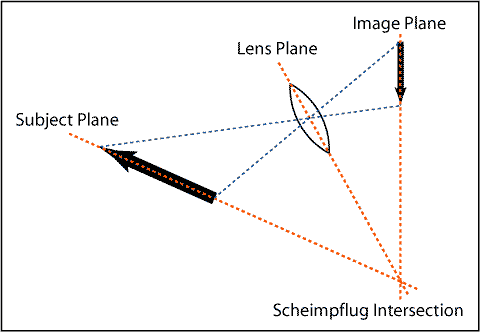
The Scheimpflug principle elegantly solves this issue by tilting the plane of focus. In a conventional camera setup, the image plane (film or image sensor), the lens plane, and the object plane are typically parallel. However, by tilting one of these planes, the Scheimpflug configuration allows for a converging intersection of the three planes, resulting in a tilted depth of field.
Historical Background:
The Scheimpflug Principle traces its historical roots back to the early 20th century and is named after Austrian army captain and inventor Theodor Scheimpflug. Scheimpflug made a significant contribution to optics by introducing this principle in his 1904 patent titled “Improvements in Photographic Apparatus for Perspective Corrections.” Born in 1865, Scheimpflug’s fascination with photography and optics led him to explore innovative solutions to challenges faced by photographers, particularly in achieving consistent focus across diverse depths in a scene.
Scheimpflug’s invention was initially conceived to address the complexities of perspective corrections in large format photography, where capturing architectural scenes often presented challenges due to variations in the distances of objects from the camera. The conventional approach of keeping the image plane parallel to the subject and lens often resulted in skewed perspectives and uneven focus. By tilting the image plane, lens, and subject, Scheimpflug’s principle allowed for a converging intersection of these planes, enabling photographers to achieve a tilted depth of field. This breakthrough had profound implications for the field of photography, offering photographers a powerful tool to enhance the clarity and depth of their images, especially in architectural and landscape photography.
In the early years following its discovery, the Scheimpflug Principle found application primarily in large format photography, where maintaining consistent focus across expansive scenes was crucial. The principle facilitated improved perspective control and depth of field in architectural and landscape images, revolutionizing the way photographers approached their craft. Over time, the Scheimpflug Principle’s applications expanded into other domains, including technical and industrial photography, where precise focusing on multiple planes became essential. The principle’s historical significance lies not only in its immediate applications but also in its enduring impact on optical design and its influence on modern imaging techniques, reaffirming its place as a cornerstone in the history of optics and photography.
Technical Explanation
Tilt-shift photography is a technique in which the lens of a camera is tilted and shifted in relation to the camera body to control the plane of focus and simulate a miniature effect. This creates an illusion that the captured scene is a miniature model rather than a full-scale environment. It’s commonly used in architectural, product, and landscape photography. The tilt-shift effect is created by manipulating the plane of focus, which allows the photographer to selectively blur certain areas of the image while keeping other parts sharp. This can be done by tilting the lens or shifting it either horizontally or vertically. By altering the amount of tilt and shift, the photographer can achieve different effects, such as creating a miniature world out of a full-scale environment or emphasizing certain elements in the image.

Applications in Modern Photography
The Scheimpflug Principle continues to be a valuable tool in modern photography, offering applications that enhance creative possibilities and technical precision. One significant application is in the realm of landscape photography. By employing the Scheimpflug Principle, photographers can achieve expansive depth of field, ensuring that both foreground and background elements are sharply focused. This is particularly advantageous in capturing scenes with intricate details or a diverse range of distances, such as sweeping landscapes or architectural compositions.
In architectural photography, the Scheimpflug Principle remains indispensable. Photographers can correct perspective distortions and achieve precise focus across the entire building or structure. This is especially useful when photographing tall structures where maintaining parallel lines and consistent focus can be challenging. By tilting the lens and image plane, architectural photographers can ensure that vertical lines remain straight, contributing to more aesthetically pleasing and accurate representations of buildings.
Macrophotography is another area where the Scheimpflug Principle proves beneficial. When capturing close-up shots of small subjects with intricate details, maintaining focus throughout the entire subject can be challenging. The principle allows photographers to strategically tilt the focal plane, ensuring that critical details across the subject are in sharp focus. This application is particularly advantageous in fields like scientific and nature photography, where precise detail capture is essential.
In portrait photography, the Scheimpflug Principle can be employed creatively to control depth of field and achieve unique visual effects. By selectively tilting the focal plane, photographers can guide the viewer’s attention to specific areas of the portrait while creating aesthetically pleasing background blur. This application provides portrait photographers with a versatile tool for crafting visually engaging and technically precise images.
Applications in Modern Photography
Beyond its application in photography, the Scheimpflug Principle plays a pivotal role in various aspects of optical design, contributing to advancements in fields such as machine vision, industrial imaging, and medical optics.
In machine vision and industrial imaging, where precision and accuracy are paramount, the Scheimpflug Principle is harnessed to optimize the focus and depth of field in imaging systems. For automated inspection processes, particularly in manufacturing environments, maintaining sharp focus across complex surfaces or objects with irregular shapes is crucial. By employing the Scheimpflug configuration, optical designers can ensure that critical features within a three-dimensional space are simultaneously in focus, facilitating accurate quality control and inspection tasks.
Medical optics is another domain where the Scheimpflug Principle finds application. In ophthalmology, for instance, where capturing detailed images of the eye is essential for diagnostics and surgical planning, the Scheimpflug Principle helps achieve precise focus in three-dimensional anatomical structures. This aids in obtaining accurate measurements and assessments, contributing to improved patient care and surgical outcomes.
In scientific instrumentation, the Scheimpflug Principle is utilized to enhance the performance of imaging systems, especially those used in microscopy and spectroscopy. Researchers can benefit from extended depth of field when imaging specimens or conducting experiments that involve intricate details across different planes. This is particularly valuable in life sciences and materials science research, where capturing clear and detailed images of specimens is crucial for analysis and understanding.
The application of the Scheimpflug Principle extends to optical systems used in astronomy. Telescopes and observatories often employ this principle to achieve optimal focus when observing celestial objects at varying distances. By incorporating the Scheimpflug configuration into the design of astronomical optics, astronomers can enhance the clarity and detail of their observations, contributing to advancements in our understanding of the universe.
Practical Tips
Photographers can leverage the Scheimpflug Principle to enhance their creative control and achieve optimal focus in various scenarios. Understanding and applying this principle can significantly improve the quality and impact of your images. One practical piece of advice is to experiment with tilting the lens and camera to create intentional depth of field effects. In landscape photography, for instance, tilting the focal plane can help maintain sharp focus from the foreground to the background, ensuring that key elements in the scene are captured with clarity. This technique is particularly useful when photographing vast landscapes with a diverse range of distances.
In architectural photography, where perspective distortion can be a challenge, using the Scheimpflug Principle helps correct converging lines and ensures that vertical structures remain true to form. Tilt your camera or lens to align the focal plane with the architectural elements, resulting in well-balanced and aesthetically pleasing compositions. This technique is particularly effective when photographing tall buildings or structures up close.
For macrophotography enthusiasts, applying the Scheimpflug Principle can make a significant difference in capturing intricate details. When shooting close-ups of small subjects, tilting the focal plane allows you to maintain sharp focus across the entire subject, enhancing the overall clarity of your macro images. This is especially beneficial when photographing subjects like flowers, insects, or other detailed textures where depth of field is critical.
Portrait photographers can also employ the Scheimpflug Principle creatively. By tilting the lens, you can control the plane of focus, guiding the viewer’s attention to specific facial features or expressions while achieving pleasing background blur. This technique adds a unique and artistic dimension to portrait photography, allowing for more intentional and visually compelling compositions.
In practical terms, mastering the Scheimpflug Principle requires practice and experimentation. Familiarize yourself with the tilt mechanisms of tilt-shift lenses or explore software solutions that simulate the effect digitally. Remember to consider the specific requirements of each photographic situation, as the optimal tilt angles may vary. By incorporating the Scheimpflug Principle into your photography toolkit, you can elevate your images with enhanced depth of field, improved focus, and a newfound level of creative control.
Conclusions
In conclusion, the Scheimpflug Principle stands as a foundational concept with far-reaching applications in optics and photography. Its historical roots in addressing the challenges of large format photography have evolved into diverse applications across various fields. Photographers benefit from the principle’s ability to extend depth of field, correct perspective distortions, and enhance creative control in capturing images with precision and clarity. Beyond photography, the Scheimpflug Principle plays a crucial role in optical design for applications such as machine vision, medical optics, scientific instrumentation, and astronomy, where achieving optimal focus across complex three-dimensional scenes is essential.
FAQs: Scheimpflug Principle
What is the Scheimpflug Principle?
The Scheimpflug Principle describes how the plane of focus changes when a lens is tilted relative to the image plane. In a Scheimpflug configuration, the lens plane, image plane, and object plane intersect along a common line, enabling sharp focus across a tilted subject plane.
How does the Scheimpflug Principle benefit photographers?
It allows photographers to extend depth of field and keep more of a scene in focus when the subject plane is not parallel to the sensor. This is especially useful in landscapes, architecture, and macro photography where the subject spans multiple distances at an angle.
Can the Scheimpflug Principle be applied in technical imaging?
Yes. The Scheimpflug configuration is widely used in industrial inspection, machine vision, scientific imaging, and medical optics to maintain sharp focus across tilted surfaces, non-flat objects, or measurement planes that cannot be aligned parallel to the sensor.
What problem does the Scheimpflug Principle solve in imaging?
It solves the limitation of a conventional setup where the object plane, lens plane, and sensor plane are parallel, causing parts of a tilted subject to fall outside the depth of field. Tilting the lens (or sensor) reorients the focal plane so more of the subject can be sharply focused.
What does it mean when the three planes “intersect along a line”?
In a Scheimpflug setup, the object plane, lens plane, and image plane are not parallel. Instead, if extended geometrically, they meet at a single common line. This geometric constraint determines the orientation of the plane of focus and how it tilts through the scene.
Is Scheimpflug the same as tilt-shift photography?
Scheimpflug explains the effect of tilting the lens relative to the sensor, which changes the plane of focus. Tilt-shift lenses combine tilt (focus plane control) and shift (perspective correction). The “miniature look” often comes from selective focus using tilt, not from shift.
Does Scheimpflug always increase depth of field?
It increases usable sharpness across a tilted subject by aligning the focal plane with the subject plane. It does not magically increase depth of field everywhere. It redistributes focus, often making one region sharper while other regions can become less sharp if they fall away from the tilted focal plane.
When is Scheimpflug most useful in optical engineering?
It is useful when the surface of interest is tilted relative to the imaging system, such as proving sharpness across a slanted conveyor belt, measuring features on a tilted part, or imaging angled anatomical structures. It enables better focus without stopping down excessively or changing working distance.
What are common applications beyond photography?
Common applications include machine vision inspection, metrology, barcode and label reading on angled packages, medical imaging of curved or tilted anatomy, and scientific imaging where the sample plane cannot be made parallel to the detector. It is also used in some ophthalmic imaging systems.
What are practical tradeoffs when using Scheimpflug tilt?
Tilting introduces alignment sensitivity, potential vignetting, and field-dependent aberrations if the lens is not designed for tilt. It can also change effective magnification across the field. In technical systems, mechanical stability and calibration become important to maintain repeatable focus geometry.
How do you know how much tilt to apply?
The required tilt depends on the angle of the subject plane, lens focal length, and camera geometry. In practice, users iterate by observing focus across the scene, while engineering systems use geometric models and calibration to lock the tilt angle that aligns the focal plane to the measurement surface.
Why is Scheimpflug linked to perspective correction in large format photography?
Large format cameras allow independent movement of the lens and film planes. Tilting and shifting these planes helps photographers keep architectural lines straight and align focus across buildings or landscapes. Scheimpflug explains the focus geometry, while shift is primarily responsible for perspective control.
When should you avoid using Scheimpflug tilt?
If the scene is mostly planar and parallel to the sensor, conventional focusing may be simpler and more robust. Tilt can also be counterproductive when subject depth is truly three-dimensional rather than lying on a single plane, since aligning focus to one plane may leave other important regions out of focus.