Introduction
In previous entries, we have talked about the design of scanning microscopes, infinity corrected microscopes, confocal microscope design, and Koehler illumination systems-a common illumination system in microscopes. The most essential microscope element in a borescope design is the objective lens.
Microscope objective lenses are a crucial part of a microscope, responsible for magnifying the specimen being observed. They are used to gather light from the object being observed and focus the light rays to produce a real image. The objective lens is one of the most important parts of a microscope, as it determines the microscope’s basic performance and function [3].
The magnification of the objective lens can vary, depending on the intended use of the microscope. For example, objective lenses for biological applications typically range from 4x to 100x, while those used for metallurgical applications can range up to 200x or more [1].
Calculating an Objective Lens Resolution
There are three design variables that can help us calculate the microscope objective resolution: the system wavelength, the light cone captured by the objective (also known as numerical aperture), and the refractive index between the first lens of the objective and the sample. This can be expressed by the following formula:
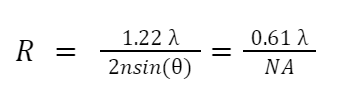
R = 1.22 /2nsin()=0.61 NA
Where R is the resolution, ? is the light wavelength, n is the refractive index, and θ is the half angle of the acceptance light cone (NA is the numerical angle defined as sin(θ)). For example, a microscope objective that works with visible light, with air surrounding the sample, and an acceptance half-angle cone of 72-degrees, will have a minimum resolution of 256 nm. If we surround the sample in a liquid with a refractive index of 1.5, our resolution will improve to 171 nm.
In the previous calculation, I assumed an angle of acceptance of 72-degrees with a reasonable upper limit when working with air (that angle gives us a NA of 0.95). However, by immersing the sample and microscope in oil or another liquid, it is possible to have a larger NA. This affects not only the resolution of our image but also its brightness (the brightness is calculated as the square of its NA).
Optical components in an Objective Lens
Objective lenses for microscopes typically have several components, including the front lens, the rear lens, the aperture, the lens barrel, and the thread. Each component plays an important role in determining the objective’s performance. For example, the aperture determines the resolution and depth of field of the objective lens, while the thread allows the objective to be attached to the microscope.
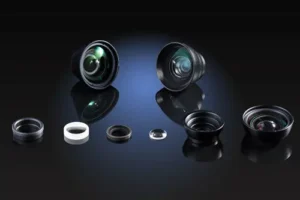
Objective lenses can have just a couple of lens elements, (an achromat and simple lens, for example) or multiple groups of elements. Even two microscope objectives with the same magnification can have a completely different design, as shown in Figure 1.
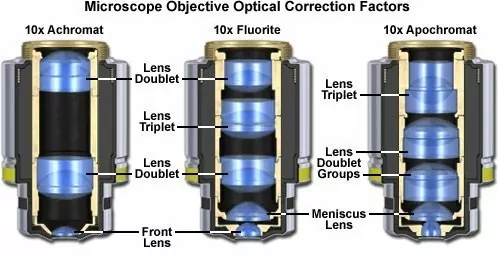
The simplest designs are usually called ‘achromat objectives’ and contain only a front lens and a couple of achromatic doublets to correct for aberrations. On the other hand, we have Apochromat microscope objectives in which several apochromatic doublets are used, in addition to some achromats for a better image quality. For a better explanation of the difference between achromatic and apochromatic lenses, please read the linked articles.
Typical Microscope Objective Markings
Most off the shelf microscope objectives have several body markings to better identify them. Typical markings can be seen in Figure 2.
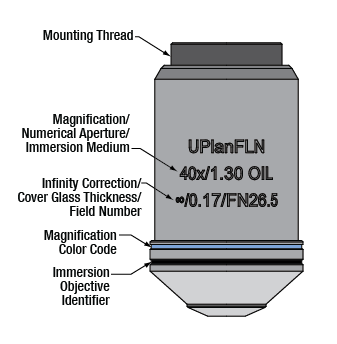
The microscope objective will show the manufacturer (not shown in the figure), followed by the type of aberration correction; in our image, we have a “Plan Achromat” which produces a flat surface at the image plane and achromat for the type of chromatic aberration.
Another specification can be “Plan Fluor” for fluorite and “APO” for apochromatic. Next we have the magnification, numerical aperture, and the immersion medium. As mentioned before, dry objective lenses usually have a NA no larger than 0.95, but that number can be considerably higher in immerse objectives. We next have an infinity symbol, meaning that the lens is infinity corrected.
In cases where the objective is not meant to be used in infinity corrected microscopes, there will be a number, usually 160) referring to the length of the microscope tube. Some microscope objectives will show the letters “DIN” which stands for “Deutsche Industrial Normen.” that sets a length of 160 mm.
Conclusions
In conclusion, microscope objective lenses are an essential part of a microscope and are used to magnify the specimen being observed. They consist of several components that work together to produce a clear image, and their magnification can vary depending on the intended use of the microscope.
FAQs: Objective Lenses
What is a microscope objective lens, and what does it do?
A microscope objective lens collects light from the specimen and focuses it to form a real intermediate image that the rest of the microscope magnifies or relays. The objective largely sets image quality because it controls numerical aperture, aberration correction, working distance, and resolution.
Why does numerical aperture matter more than magnification for image quality?
Numerical aperture (NA) defines the acceptance cone of light the objective captures. Because resolution improves as NA increases, two objectives with the same magnification can produce very different detail. Higher NA also increases image brightness, typically scaling with NA squared.
How is objective lens resolution estimated using NA and wavelength?
A common estimate is the diffraction-limited lateral resolution: R ≈ 0.61 λ / NA. Because resolution depends on wavelength and NA, shorter wavelengths and higher NA improve detail. This is an ideal limit and can be reduced by aberrations, alignment, and sample conditions.
When should an immersion objective be used instead of a dry objective?
Immersion objectives are used when higher NA and improved resolution are needed beyond what air allows. By using a medium with higher refractive index (oil, water, or other liquids), the acceptance cone increases, enabling more captured light, better resolution, and brighter images at the same magnification.
What is the practical tradeoff of higher NA objectives?
Higher NA often reduces depth of field and can shorten working distance, making focusing and sample handling more sensitive. It also increases sensitivity to cover glass thickness, refractive index mismatch, and alignment. These factors can introduce blur or spherical aberration if the setup is not matched.
Why can two 10x objectives have very different internal designs?
Magnification alone does not specify correction level, field flatness, or compatibility with tube optics. A 10x achromat may use fewer elements, while a 10x apochromat often uses multiple groups to better control chromatic and other aberrations. Design choices target different performance and cost points.
What is the difference between achromat and apochromat objectives?
Achromat objectives correct chromatic aberration to a basic level, typically over fewer wavelengths and with simpler element groups. Apochromat objectives use more complex correction to reduce chromatic and other aberrations more aggressively, improving sharpness and color fidelity across the field for demanding imaging tasks.
What does “Plan” mean in objective lens markings?
“Plan” indicates field flattening, meaning the objective is designed to produce a flatter image plane so the edges stay in focus along with the center. Plan objectives are especially useful for imaging and metrology where sharpness across the full field of view matters.
What does the infinity symbol mean on an objective lens?
An infinity symbol indicates an infinity-corrected objective, which outputs collimated light when the specimen is at the focal plane. These objectives are intended to be used with a tube lens that forms the intermediate image. This architecture supports modular optics like filters, beam splitters, and additional relay components.
What does the “160” marking mean on some objectives?
A “160” marking typically refers to a finite tube length system, where the objective is designed to form an image at a fixed mechanical tube length, commonly 160 mm. Using a finite objective in an infinity system (or vice versa) can cause focus issues and performance degradation.
What is “DIN” on objective lenses and why does it matter?
“DIN” refers to a standardized mechanical and optical convention historically associated with 160 mm tube length systems and standard parfocal distances. It helps ensure interchangeability of objectives within compatible microscope bodies. Mixing standards can lead to incorrect tube length, focus travel issues, or suboptimal image quality.
Which objective markings are most important for choosing the right lens?
Magnification, NA, immersion medium, correction level (Achromat, Fluor, APO), and system type (infinity or finite) are the most critical. These markings determine resolution, brightness, aberration performance, compatibility with the microscope tube optics, and whether the objective matches the sample environment.